
What Rwanda’s Fourth National Communication Report Reveals About Emissions, Adaptation and Climate Finance?
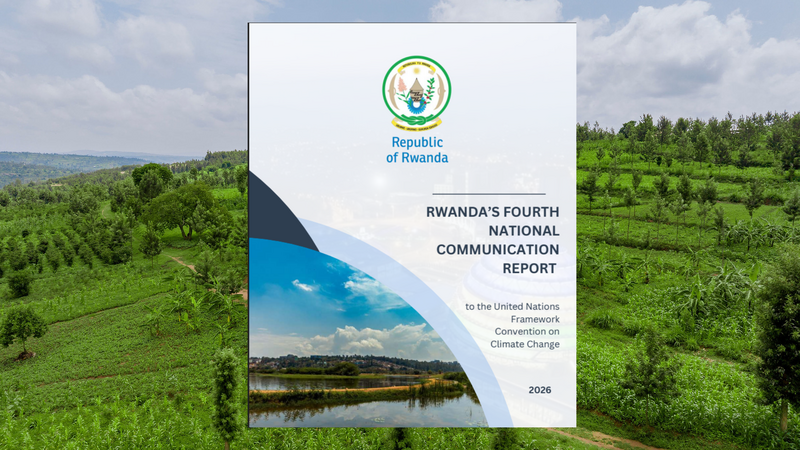
What does climate change mean for Rwanda? How much do our daily activities contribute to greenhouse gas emissions? And what can the country do to protect farmers, communities, forests and future generations from climate change impacts?
These are some of the important questions addressed by Rwanda’s Fourth National Communication Report on Climate Change, published in 2026.
The report was prepared by the Government of Rwanda for the United Nations Framework Convention on Climate Change (UNFCCC), and it provides an updated picture of the country’s climate situation. It examines greenhouse gas emissions, climate risks, measures to reduce emissions, adaptation efforts, and the financial and technical support needed to strengthen climate action.
Beyond its technical information and statistics, the report tells a story about Rwanda’s development and how the country can grow while protecting its people and environment. This makes the report relevant not only to environmental professionals, but also to farmers, businesses, policymakers, local government authorities and ordinary citizens.
What is the key source of greenhouse gas emissions?
The report’s national greenhouse gas inventory estimates that agriculture contributed approximately 58% of Rwanda’s greenhouse gas emissions in 2022, excluding emissions and removals from land use, land-use change and forestry. A major source is livestock, particularly methane released during the digestion of ruminant animals such as cattle Manure management and emissions from agricultural soils.
This highlights an important point: climate action in Rwanda is not only about reducing emissions from cars, factories or electricity production. It also involves improving livestock management, soils conservation, using fertilisers efficiently and promoting sustainable farming practices.
The report identifies measures such as composting, crop rotation, terracing, mulching and improved manure management as options that can support both agricultural productivity and climate action.
Transport emissions are growing rapidly, but more solutions are in place
As Rwanda develops, the demand for transport, electricity, housing and other services continues to grow.
The report estimates that greenhouse gas emissions from the energy sector reached approximately 2.65 million tonnes of carbon dioxide equivalent in 2022. Transport accounted for around 47% of these energy-sector emissions.
Transport emissions increased from approximately 360,000 tonnes of carbon dioxide equivalent in 2006 to about 1.25 million tonnes in 2022.
This trend highlights the importance of cleaner mobility, more efficient vehicles, public transport and electric mobility as Rwanda continues to urbanise.
The challenge is to meet people's growing transport needs while limiting air pollution, fuel consumption and greenhouse gas emissions.
What happens to our waste also matters!!
Waste management is another important part of Rwanda’s climate story. According to the report, the waste sector emitted approximately 2.23 million tonnes of carbon dioxide equivalent in 2022. Wastewater treatment and discharge accounted for around 53% of methane emissions from the sector, followed by solid waste disposal sites at 35%.
Why does this matter? When organic waste decomposes under conditions with little or no oxygen, it can generate methane, a powerful greenhouse gas. Methane can also be produced during the breakdown of organic matter in wastewater systems.
The report identifies opportunities to reduce these emissions through improved wastewater treatment, better management of disposal sites, composting and methane recovery.
Better waste management can therefore deliver benefits beyond cleaner neighbourhoods. It can also contribute to Rwanda’s climate goals.
Rwanda’s forests are part of the climate solution
Forests and other forms of land cover play an important role in absorbing carbon dioxide from the atmosphere. They also support biodiversity, protect water resources, reduce soil erosion, and provide livelihoods.
The report cites approximately 724,695 hectares of forest cover, equivalent to about 30.4% of Rwanda’s land area.
However, protecting forests is only part of the challenge. Rwanda must also ensure that forests remain healthy and capable of storing carbon as the country develops.
Sustainable land management, agroforestry, forest restoration and the protection of natural ecosystems can help strengthen this role.
Looking ahead: how Rwanda tends to reduce emissions?
One of the report’s important messages concerns Rwanda’s future greenhouse gas emissions.
Under a business-as-usual scenario “a projection of how emissions could evolve without additional mitigation measures beyond those assumed in the baseline emissions excluding land-use change and forestry” are projected to rise from approximately 12.1 million tonnes of carbon dioxide equivalent in 2022 to 31.7 million tonnes by 2035.
This is a projection, not an inevitable outcome.
The report also assesses how additional measures could change that trajectory. These include expanding cleaner energy, promoting electric mobility, improving agricultural practices, reducing emissions from industrial processes and capturing methane from waste.
Rwanda’s updated Nationally Determined Contribution, known as NDC 3.0, sets a target of reducing emissions by 53% below the business-as-usual level by 2035. Achieving this ambition will require sustained implementation, investment, appropriate technologies and cooperation across sectors.
Adapting to climate change: Protecting people and livelihoods
Reducing greenhouse gas emissions is only one part of the climate response. Rwanda must also adapt to climate change that is already affecting, or is expected to affect, its people, economy and natural environment. This is the highest priority considering the vulnerability of the country.
The report assesses climate risks and adaptation options across key sectors, recognising that different parts of the country face different challenges. These include drought and water stress, flooding, landslides, soil erosion, damage to infrastructure and risks to ecosystems and public health.
In agriculture, adaptation measures include expanding irrigation, promoting drought-tolerant crops, improving soil conservation and strengthening access to climate information. These measures can help farmers manage unpredictable rainfall, protect harvests and maintain food security.
In water resources, the report highlights integrated water resources management, catchment restoration, improved flood forecasting and nature-based solutions. Protecting wetlands and restoring degraded landscapes can help regulate water flows, reduce erosion and strengthen resilience to floods.
In infrastructure and settlements, climate-resilient road and housing designs, improved drainage, better land-use planning and early warning systems can reduce damage from floods and landslides.
In health, stronger disease surveillance, resilient healthcare facilities and improved water, sanitation and hygiene services can help communities respond to climate-sensitive health risks.
In forestry and biodiversity, restoring degraded ecosystems, protecting forests and improving landscape management can help conserve biodiversity while supporting communities whose livelihoods depend on natural resources.
How much support does Rwanda need to address climate change?
Implementing climate action requires more than policies and good plans. It also requires adequate financing, appropriate technologies, skilled professionals, reliable data and strong institutions.
Rwanda’s NDC 3.0 estimates total financing needs of approximately US$12 billion for mitigation and adaptation. For adaptation alone, the report identifies financing needs of approximately US$7 billion over 2025–2035. Of this amount, about US5.4 billion depends on external financing.
Agriculture and water resources account for the largest shares of the identified adaptation financing needs, reflecting their importance for food security, livelihoods and water security.
Beyond finance: Rwanda also needs technology, data and skills
The report identifies several technical and institutional gaps that need to be addressed to strengthen climate action.
These include improving the availability and quality of climate and greenhouse gas inventory data, developing national technical expertise, strengthening climate research and systematic observations, and improving the ability of institutions to assess climate risks and monitor progress.
Access to appropriate technologies is also important. This includes technologies for climate-resilient agriculture, water management, renewable energy, waste treatment and early warning systems.
The report further highlights challenges in mobilising climate finance, including limited resources in district budgets, insufficient financing for major projects, limited private-sector participation and difficulties accessing and coordinating funding.
Addressing these gaps will require cooperation between government institutions, research organisations, the private sector, development partners and local communities.
What does the report mean for ordinary Rwandans?
The Fourth National Communication is more than a document prepared for an international climate convention. Its findings have practical implications for everyday life.
For farmers, it highlights the importance of climate-resilient agriculture, improved soil management and better access to climate information. For urban communities, it emphasizes the value of improved drainage, resilient infrastructure, cleaner transport and effective waste management.
For businesses and industries, it points to opportunities to improve energy efficiency, adopt cleaner technologies and manage emissions, while for local government authorities, it provides evidence to support climate-informed development planning, disaster preparedness and investment in resilient communities.
For the country as a whole, it reinforces the importance of mobilising resources, strengthening institutions and ensuring that climate action reaches the people and sectors most exposed to climate risks.
Read the full report: Rwanda’s Fourth National Communication Report to the UNFCCC (2026)